

China's Innovative new Uncrewed Submarine Mothership
CLICK to Enlarge
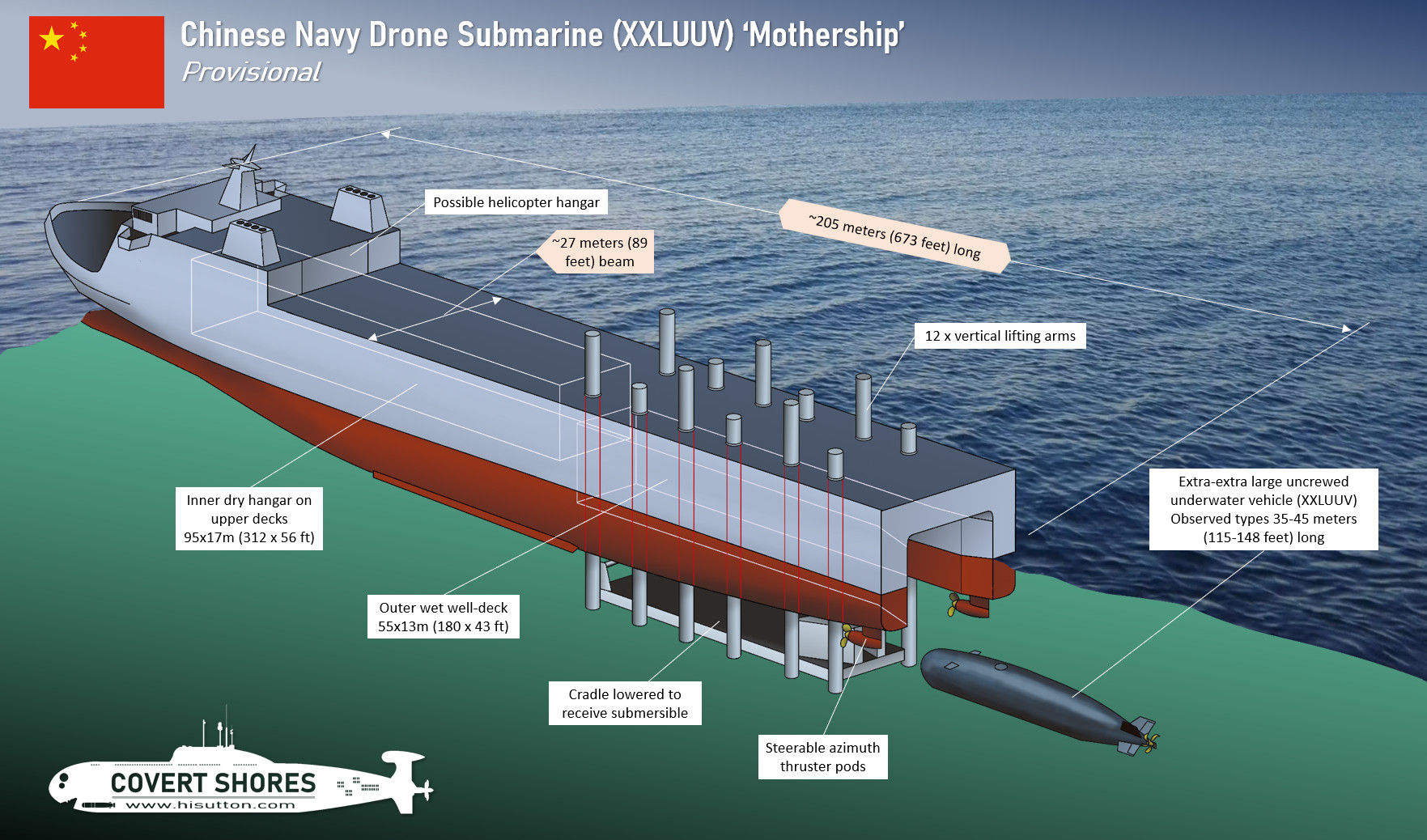
 China is building a new form of drone mothership, one large enough and specially shaped and equipped, to carry drone submarines. The vessel is under construction at the Hudong-Zhonghua shipyard in Shanghai.
The size and configuration points to the carriage of full-sized uncrewed submarines. Termed XXLUUVs (extra-extra large uncrewed underwater vehicles), the ones observed in China are around 35-45 meters long.
I gave a talk on Chinese submarine and XXLUUV developments a few months ago where I suggested that the construction of special floating docks would be a leading indicator of the operationalisation of China’s uncrewed submarine program. And now here we are.
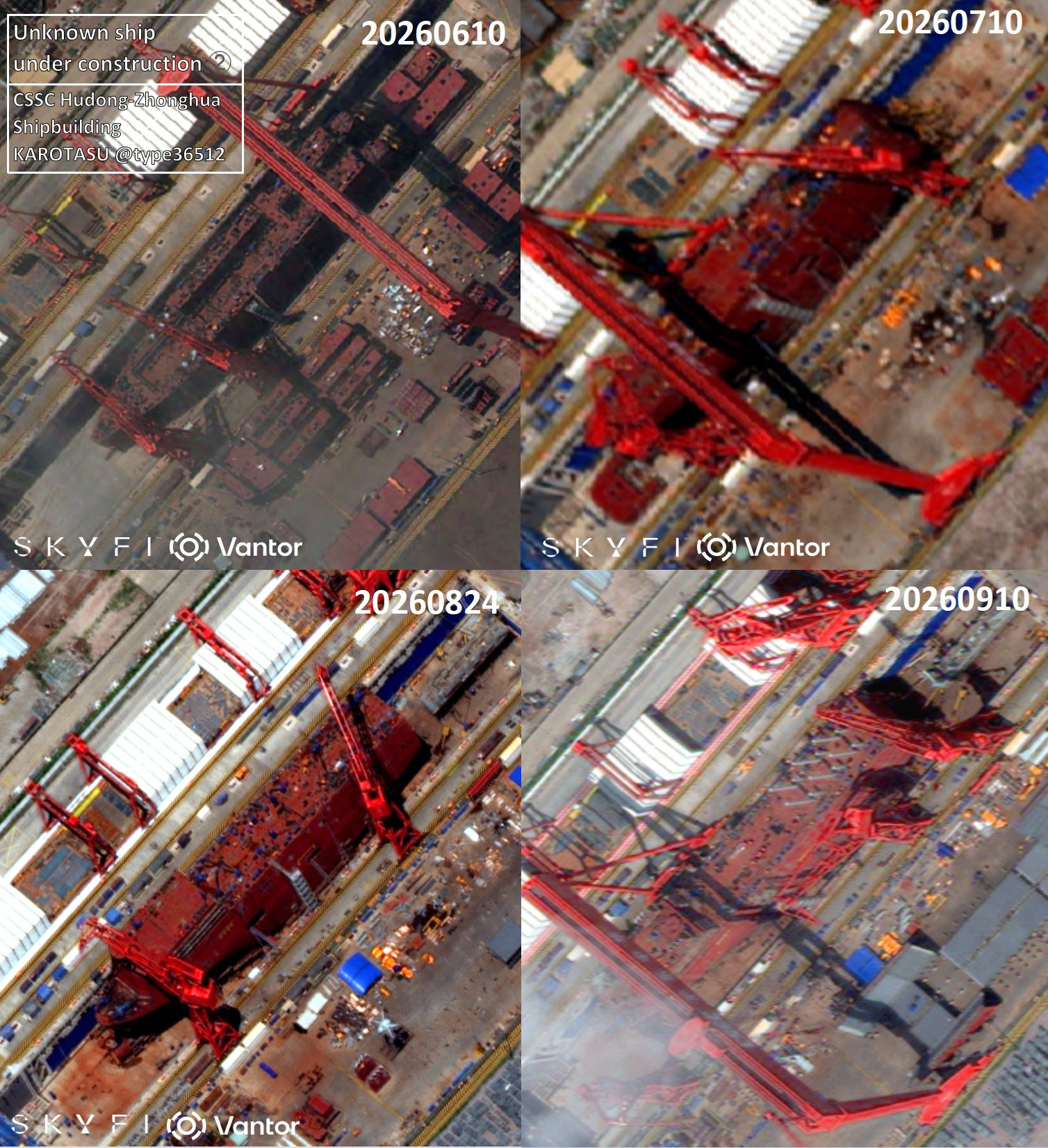
Click to Enlarge. Satelite imagery from Vantor Technologies, shared online by ‘KAROTASU’ (@type36512) on Twitter.
Mothership for Uncrewed Submarines
The vessel fills a clear need. Larger UUVs start needing port infrastructure to support them, they become much less convenient to move around. With smaller UUVs, even up to 20 meters like the AJX-002 and HSU-100 paraded in Beijing last year, they are road mobile. Truck mounted cranes should be sufficient for getting them in and out of the water making operations much simpler. With these latest, much larger XXLUUVs however, China will start to need dedicated port facilities. This mothership is likely a major part of the solution.
Until now China has been using floating docks to house the two XXLUUV prototypes being tested on Hainan. One of these docks was purpose built while the other may have been taken up from general use. These keep the vessels out of the water for maintenance and allow them to be moved well outside the port before being launched or recovered. This latter arrangement must greatly simplify testing, avoiding operating the uncrewed vessels in close proximity to other ships and port obstacles. However this arrangement also has a significant drawback: each floating dock can only carry a single XXLUUV. Or if more than one, then they both need to be placed in the water at the same time. Because the whole dock floods, there cannot be one undergoing maintenance while another is being launched or recovered.
The new mothership solves this by having a dry hangar for stowage and maintenance, and a separate lifting well for launch and recovery. Based on the relative sizes, the hangar can accommodate 2-4 XXLUUVs (or many more smaller XLUUVs), while the lifting cradle in the well deck can accommodate one at a time.
Well Deck
The well deck is at the stern, similar to on a landing ship dock (LPD), but without a bottom to it. Instead it has a cradle platform which can be lifted in and out of the water on 12 vertical jack-up arms. The well deck is around 55 meters long, which is one of the factors pointing to XXLUUVs open bottom: it’s much larger than necessary for any rescue or research submersibles.
The open well deck is a useful identification feature. The resulting keel block arrangement this creates can be seen in satellite imagery even before any sections of the actual ship have been assembled. And the jack-up arms protrude above the box-like hull.
The dry hangar is forward and positioned above the waterline. It is around 95x17 meters and several (many) decks high. The rest of the ship is built around these spaces. The superstructure is well forward, creating an overall box-like ship generally resembling a very large RO-RO ferry.
The vertical lifting cradle is unique. A conceptually identical arrangement has been seen on a proposed Chinese scientific research mothership, but on a smaller scale. Similar Jack-up legs have also become characteristic of China’s innovative mobile harbours.
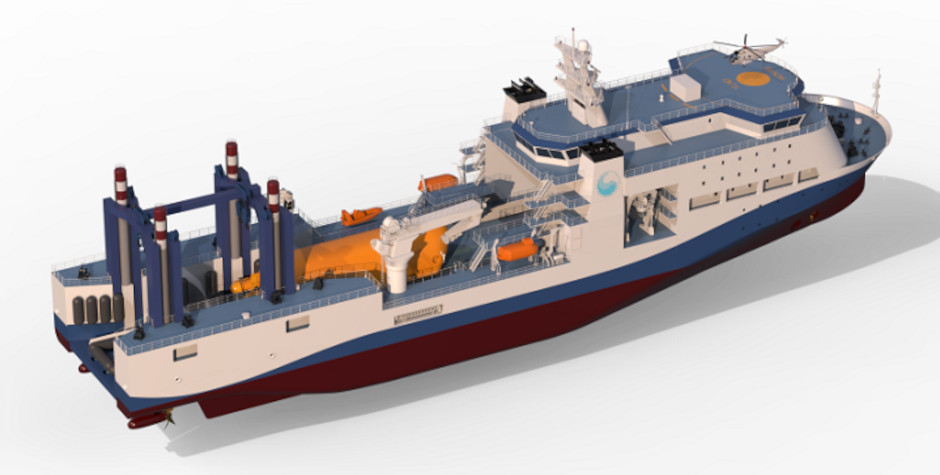 An essentially similar concept, but on a smaller scale and without the covered hangar, was talked about in 2025 as part of the ‘Cold Seep Ecosystem Research Facility’, a ‘National Major Science and Technology Infrastructure’.
Other Submarine Motherships
There have been other submarines motherships, particularly during the early days in the 1900s. The French special cargo ship SS Kanguroo was built in 1912 for delivering submarines to export customers. She had a gangster inside with a bow-door opening. A few years later the the Brazilian Navy’s Ceara was built as a submarine tender with a unique pressure chamber built into the stern. Submarines could be floated in for maintenance which including pressurising the chamber to test the submarine’s hull. The weakness of these fascinating designs was that submarines quickly outgrew them, being generally too large for their hangars. In more recent times South Korea has operated the ROKS Dadohae (ASL-50) special floating dock for its special forces midget submarines. While Pakistan made a much less exotic side-lifting crane for similar sizes midget submarines at its main operating base in Karachi.
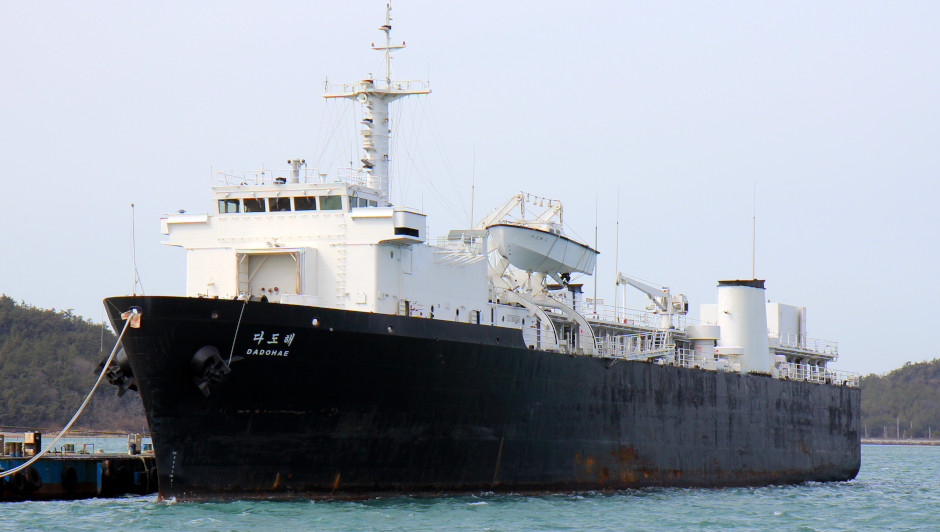 Not what she might first appear. South Korea’s ROKS Dadohae (ASL-50) is a floating dock/mothership for the country’s Italian designed Cos.Mo.S midget submarines.
Outlook
China is, as we’ve come to expect, leading the way in future naval capabilities. These special motherships will likely act as submarine tenders in port, but also transport the XXLUUVs within strike range of targets. Given that we estimate an operational range of 10,000 nautical miles, this can still be a long way from the target.
At this time the next question is whether this is a ‘grey navy’ PLAN (People’s Liberation Army Navy) hull, or a quasi-naval commercial hull operated by the shipyard. The lines between traditional navy and commercial fleets have blurred in China with full-sized drone carriers operated, ostensibly at least, by the ship building corporations. Up to a point this will be mute however, I take the construction of this vessel as a strong indication of evolving Chinese war fighting capabilities. The Chinese Navy (PLAN) is outpacing the rest of the world in naval innovation and ambition as well as just shipbuilding output.
Related articles (Full index of popular Covert Shores articles)

 Ceara; Brazil’s unique Submarine Transport Ship With Hidden Hangar, 1915 w/Cutaway
 Armored Stealth Boat used for car smuggling by Chinese organized crime. w/Cutaway
 Chinese Sea Wing UUV (Glider)