

Grillo Ingenious Italian Jumping Torpedo Boat Of WW1
 During World War One the Italian flair for technical inventiveness and unconventional thinking was applied to the problem of the Austro-Hungarian Navy in the Mediterranean. Neither side wanted to risk the massive open-sea gunnery matches between battleships that everyone expected would be the nature of naval battles in the age of the Dreadnought. In terms of numbers, they were relatively evenly matched: the Austro-Hungarians had thirteen battleships and Italy fourteen at the start of the war.
The Austro-Hungarians, in particular, opted to keep their ships in port, partly due to a shortage of coal for their boilers, but more to avoid the massive showdown. Besides, the Austro-Hungarians, aided by their German allies, found that submarines were a far more potent threat in the Adriatic. By keeping their battleships safely protected in their ports they could maintain the threat of decisive naval action without risking failure.
The Boom Problem
The Austro-Hungarian port defences were influenced by the earlier successful harbour raids by larger submarines, including a successful attack by Royal Navy’s HMS E11 on Constantinople and several attempts by the French. Consequently, the defences at their main base of Pula consisted of anti-torpedo/submarine nets (known as booms) which presented a very real challenge to the Italians keen to neutralize the threat of the battleships. In the absence of the colossal naval battle in open waters that both sides seem to have feared, attack in port was the only real way to deal with the battleships and so new approaches were needed.
The Italians had had some success with a new weapon, small fast torpedo boats, but the nets neutralized this option when it came to attacking Pula. In answer to the net defences Italian naval engineers started to come up with clever schemes to get around, or more specifically over, the defences and strike a blow right to the heart of the Austro-Hungarian fleet.
The Grillo – Jumping Boat
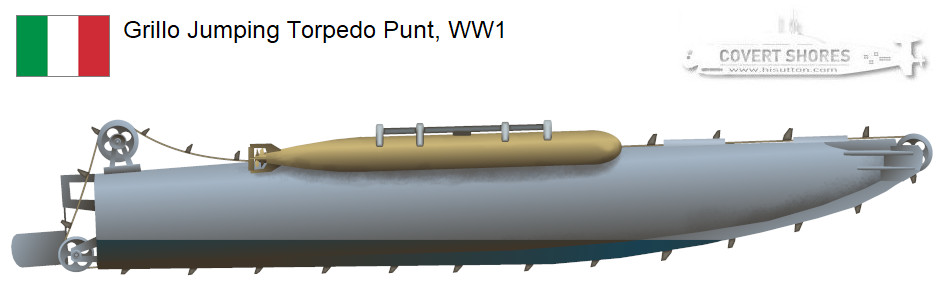
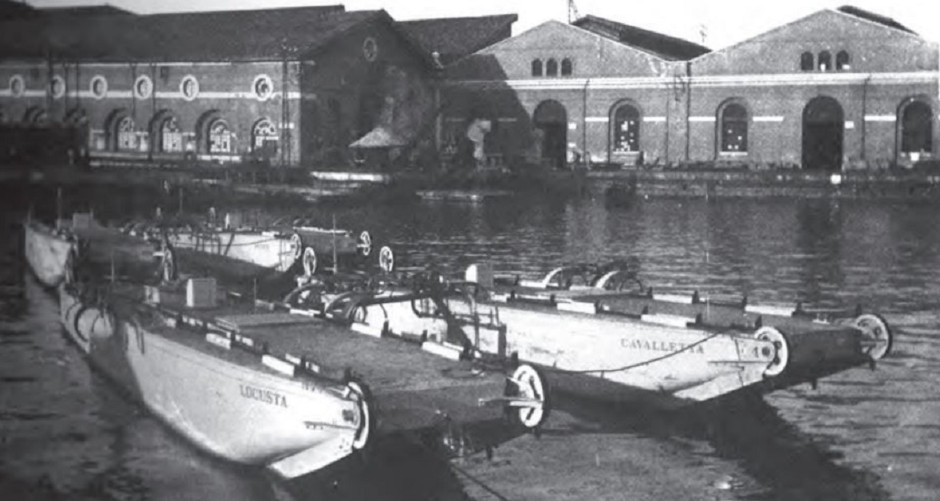
The first ingenious approach was termed a Barchino Saltatore (jumping punts), often known by the name of one of the craft, the Grillo (Italian for Cricket). They were essentially a small torpedo boat designed to climb over floating obstacles such as torpedo nets. Development of the first jumping punts started in 1917. The punt was a small wooden boat of about eight tonnes, 16m (52ft) length and just 3.1m (10ft) beam. It was generally not considered seaworthy due to its small size and slow speed but it was suitable for operations in sheltered waters such as harbours, which was the point.
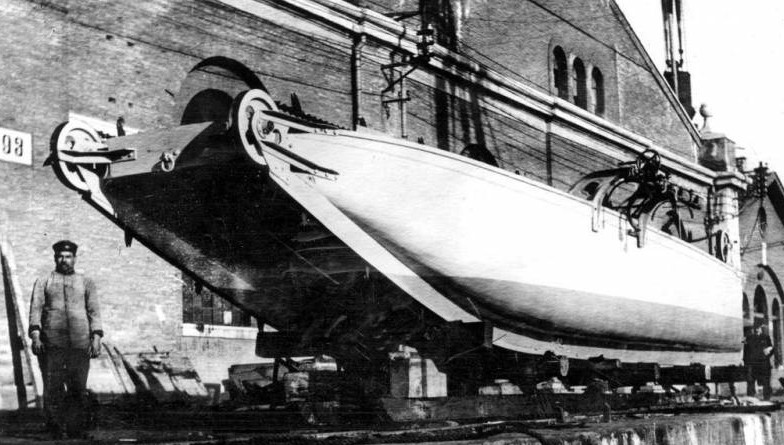
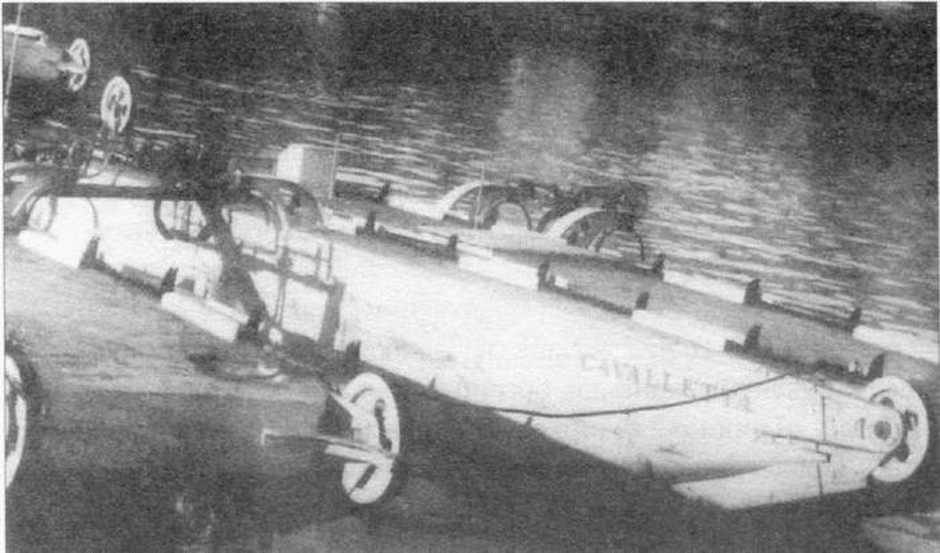
It had a four-man crew and carried two 450mm (17.7”) torpedoes on davits that could be swung out over the side of the boat to allow the torpedoes to be dropped into the water. The torpedoes were smaller than later ‘heavyweight’ 533mm (21”) standard torpedoes but were still powerful enough to sink a battleship if it lacked the increased thickness ‘torpedo bulge’ armour along the waterline. The real limitation of the torpedoes was their short range, but since they had to be fired from within the innermost torpedo net this was less of a problem.
The problem was getting that close in the first place, which is where the innovation lay. The punt’s defining feature was a track-like chain with hooks in it that ran around each side of the boat, very similar to a tank track. The reference to “tank tracks” would have been lost on the designers because tanks had barely been invented then and were probably largely unknown to them in design terms, but the analogy is strong. Using a hooked chain suspended between three wheels, the boat could crawl over the net defences, a capability not possessed by any other craft in existence.
Another interesting feature is that the main motor was electric rather than a combustion engine so it would have been a lot quieter. The motors were quite weak however at just 2 horsepower and the craft was therefore very slow being capable of only five knots. The names given to these craft implies that they could leap over the nets, but the reality was more of a crawl. As well as the tracks, the motors drove a small propeller at the rear, and interestingly this was mounted higher than the tracks so that it wouldn’t snag on the obstacle.
Into Action
The first attack on Pula launched by two Grilli in April 1918 was unsuccessful. Although the two craft started their attack at night, their slow speed meant that they were still on their way through the defenses at daybreak and were easily spotted. With no means to escape or return fire the punts had to be scuttled.
The Italians were not deterred and on 14th May 1918 another punt, named Grillo and commanded by Captain Mario Pellegrine, made an attempt on the key port of Pula. The battleships were defended by some five layers of nets, and using the tracks, Pellegrine was able to pass the first four without being spotted. On the last obstacle they were spotted by a harbour-defense steamer which was patrolling the area. The defenders opened up with cannons and machine guns against the slow moving and unarmoured craft. Taking overwhelming incoming fire, the Italians reluctantly had to scuttle their craft like the previous two and swim for shore where they were captured.
Copycat – the Barrikadenkletterboot
Because he’d got so much closer to his target, Pellegrine’s craft had sunk in much shallower water. Within days the Austro-Hungarians had raised the Grillo and discovered its secrets. They immediately set about making it seaworthy again and testing it. They were so impressed that they ordered production of a copy known as the Barrikadenkletterboot (German for Barricade Climbing Boat).
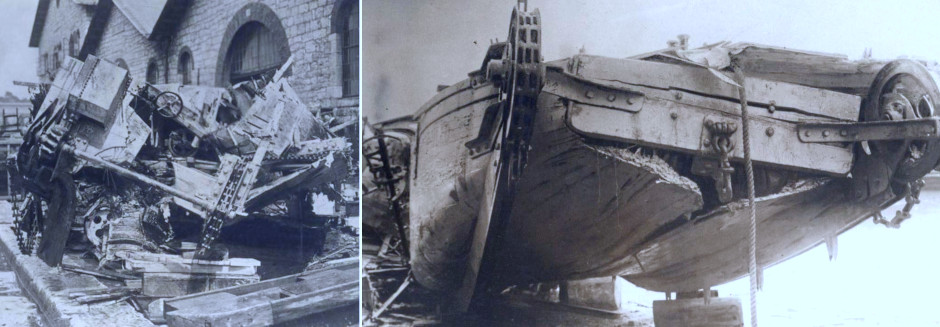 Austro-Hungary recovered a scuttled Grillo and reverse engineered it.
The Austrian copy had a more box-like appearance than the Grillo, and was very slightly larger, more powerful and faster, but was in practical terms comparable in almost every respect. The Austrians did manage to reduce the crew from four to three men but the operational profile was identical with the same advantages and disadvantages. Fortunately for the Italians the knock-off came too late to see any action.
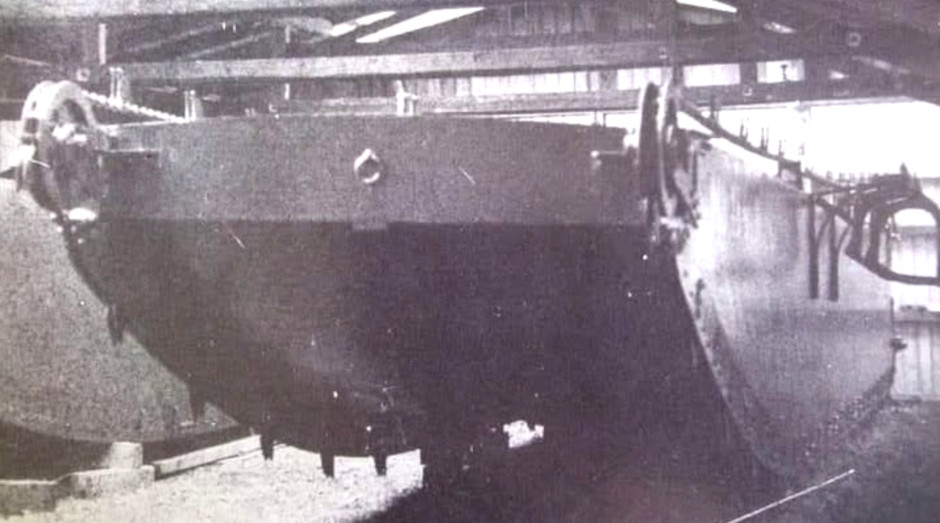 Barrikadenkletterboot
Related articles (Full index of popular Covert Shores articles)
 Mignatta first human torpedo

 Decima MAS attack on New York 1943 (CA Class)