

OSINT: Indications Russia Will Re-Route LNG Exports Via Arctic To Avoid Ukrainan Threat
 A Russian LNG (liquified natural gas) tanker, Portovyy (IMO 9246621), has sailed out of the Baltic. Unusually, confusingly, her declared destination of Murmansk in Russia’s Arctic. It is unlikely that she is really going there. Although it is too early to declare it a fact, this may be an early indication that Russia is deploying a new tactic to avoid Ukrainian surface drone (USV) threats.
The ship loaded its cargo at Portovaya near St. Petersburg (vicinity 60.5093°, 28.1779° - about as far from the Russian city and as close to the Finnish border as is possible for the dangerous product) and is being escorted out of the Baltic by the Russian Navy Pr. 22350 Gorshkov Class frigate Admiral Kasatonov.
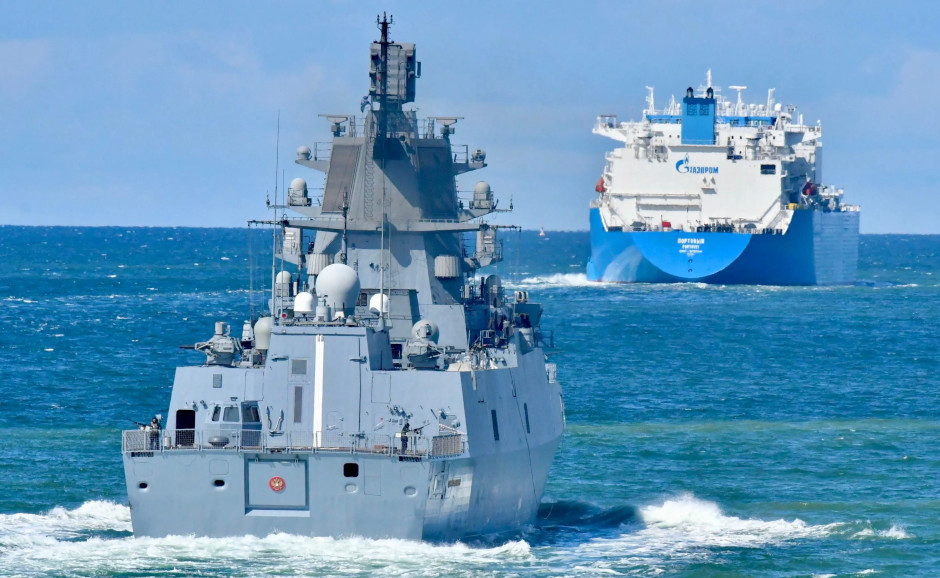 Portovyy escorted by Admiral Kasatonov today. Photo via Frank Behling, BlueSky.
It is unlikely that the ship, laden with LNG, will actually sail to Murmansk as the final destination; Russia does not need to export LNG to itself. Instead, its cargo is likely for East Asia, presumably China. This would involve sailing across the Northern Sea Route (NSR). So the cargo either needs to be transhipped to another tanker for the journey, perhaps a better ice-hardened one, or Portovyy has to sail there herself. I would expect the latter, but if a transhipment is made it may be in a fjord just west of Murmansk.
Sending LNG tankers from the Baltic export terminals, around the top of Russia, to the Pacific would be a new tactic. LNG tankers do sail across the top of Russia, but from the gas terminals there, not from the Baltic. Only one LNG tanker has made the transit from the Baltic before, Velikiy Novgorod in 2023, and that appeared to be more of a test or demonstration. And none sailed this way in the past two years, although several crude oil tankers did. Instead, LNG cargos from the Baltic have been sailing south through the Mediterranean/Suez or around Africa.
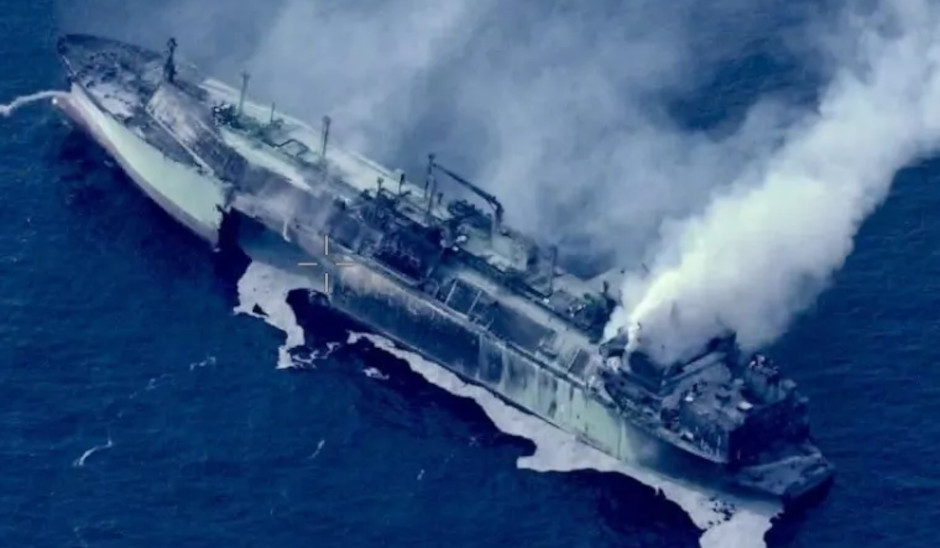 The Russian shadow fleet LNG tanker Arctic Metagaz after being struck by surface drones (USVs) in the Mediterranean. The ship wasn’t fuelled by LNG, but the massive explosions, which blew out whole sections of the double hull.
Since 2022 Portovyy has been anchofred near Portovaya as floating storage unit (FSU) for LNG. But this doesn’t match with her current voyage which appears fully laden, so her role has logically changed to that of a regular vessel.
The NSR promises a shorter route during its summer ‘open’ season, and it avoids the war-torn Middle East. But these are unlikely to be the determining factor. It is more likely the success of Ukrainian surface drones (USVs) in blowing up LNG tankers outside the Black Sea (see Arctic Metagaz although Ukraine has not claimed credit). LNG cargoes are particularly vulnerable, and Russia is thus adapting to the Ukrainian threats to keep its important economic lifeline to fund its war in Ukraine open.
Related articles (Full index of popular Covert Shores articles)

 Guide to Ukraine’s naval drones (USVs)
 Ukraine’s long-ranged attack drones (OWA-UAVs)