

Second Chinese Uncrewed Submarine Mothership
CLICK to Enlarge
 Unique naval technologies require unique support vessels. China’s unparalleled uncrewed submarines (XXLUUVs - extra-extra large uncrewed underwater vehicles) now have two special motherships. These vessels feature a unique submarine lift system in the stern which is lowered directly down through a gap in the ships bottom. The second mothership was launched in Guangzhou earlier this month.
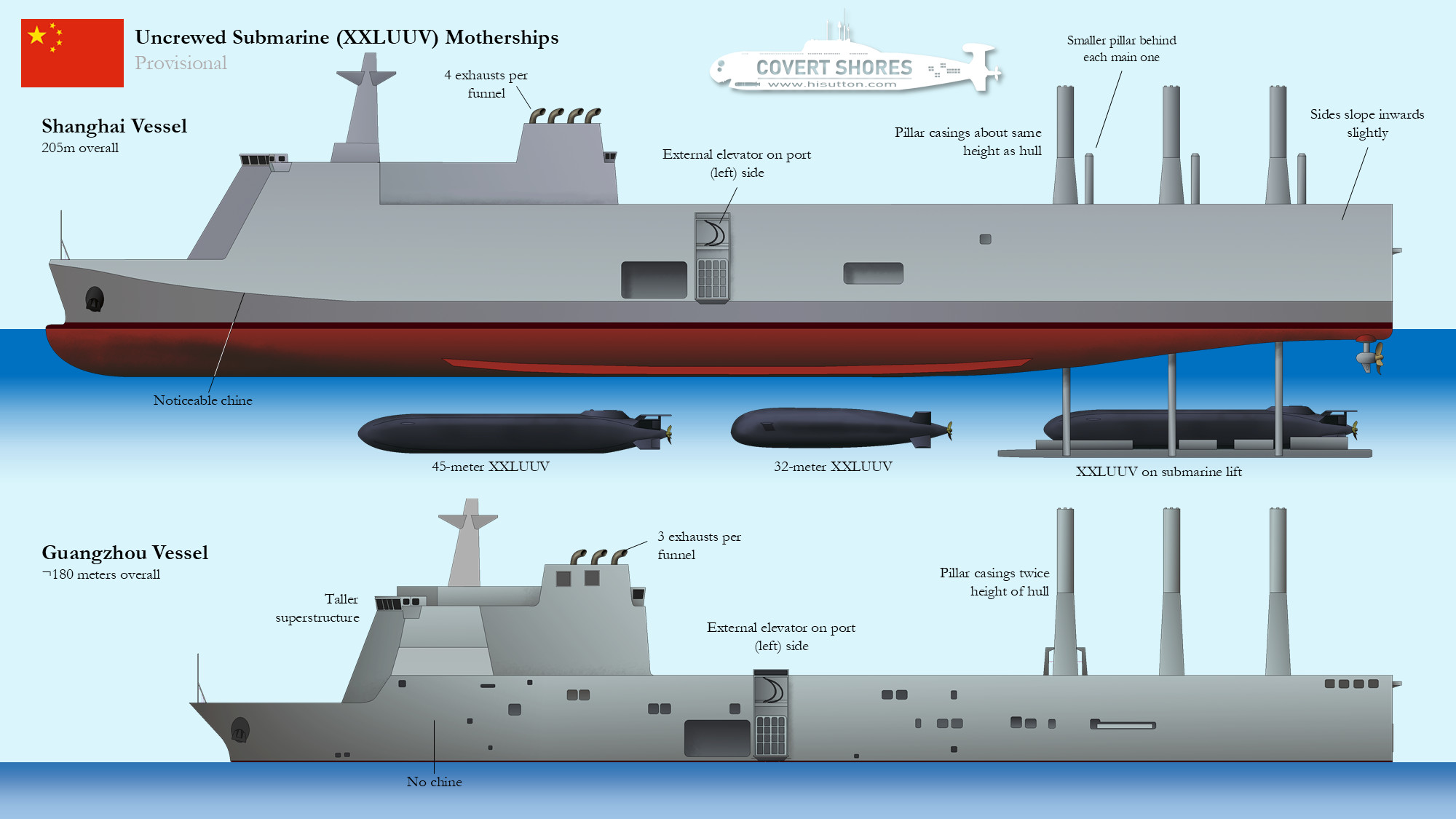
Although both ships appear to have the same basic layout and key features, including the submarine lift, but differ in hull size and form, the second vessel is a different design to the earlier one built in Shanghai. It is slightly shorter (approximately 180 meters / 590 feet versus 205 meters / 673 feet) and is a couple of decks lower along its length. We can deduce that it has a slightly shallower draught and smaller displacement. Having said that, it’s still a very large ship and likely has the same capacity to carry and launch /recover uncrewed submarines.
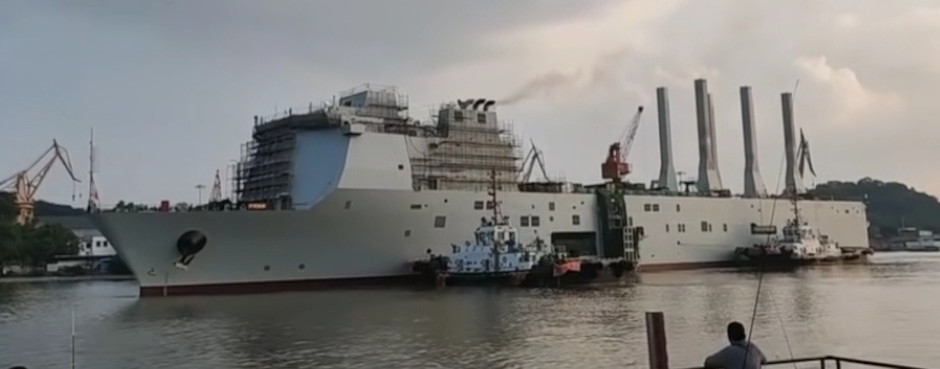 The second mothership has been built in Guangzhou.
Uncrewed Submarines
There are at least two types of uncrewed submarine under testing, one around 35m (115 ft) and the other around 45 meters (148 ft) long. Both are likely armed, and represent an unrivalled underwater capability. There is nothing comparable in terms of size or program scale and maturity anywhere else in the world, and there is a conspicuous absence of comparable programs to catch up. For context, the United States’ Boeing Orca XLUUV, although impressive, is about 1/8th the size of these vessels.

CLICK to Enlarge
The size of these uncrewed submarines is impressive, but it brings with it operational challenges. It is apparent that China has avoided the complication of operating them in ports where uncrewed navigation is difficult (and usually against local port rules) and instead launches them from special float docks out at sea. But these floating docks are limited to a single vessel at a time. The new mother ships can carry several uncrewed submarines at once, possibly 4 at a time.
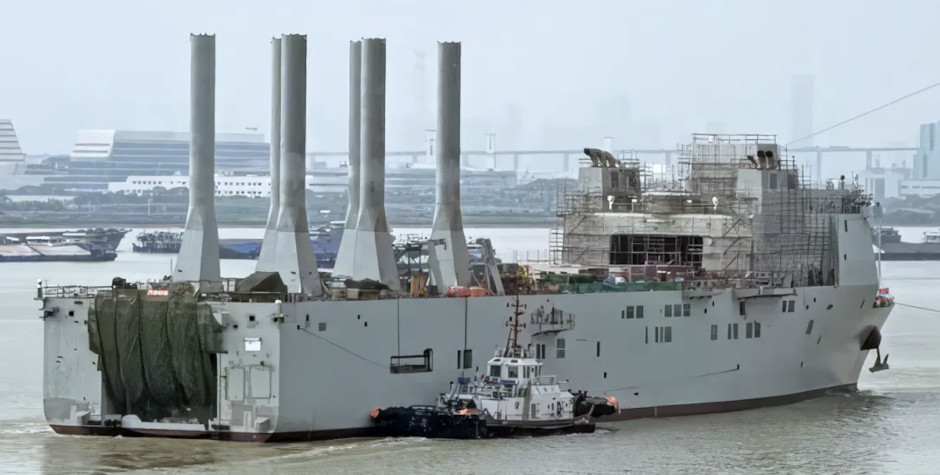 Second vessel in Guangzhou, showing the split transom with lifting cradle (partly hidden behind a screen).
Differences
The cradle system appears almost identical the first ship. The first pair of lifting pillars are approximately 52 meters forward of the stern, and the gap between the two rows of 3 is about 10 meters wide. The overall length of the cradle slot is about 58 meters (190 feet) long and 7 meters (23 feet) wide, which indicates the largest XXLUUV which could be handled. On both vessels the lifting pillars are encased in an outer steel tube around 2.5 meters (8 feet) in diameter with prominent flared base supports. On the second ship however these are however much taller than on the first boat at approximately 26 meters )85 feet) tall compared to only about 17.5 meters (57 feet). This implies that the second vessel’s hull is lower, or that the cradle can descend deeper.
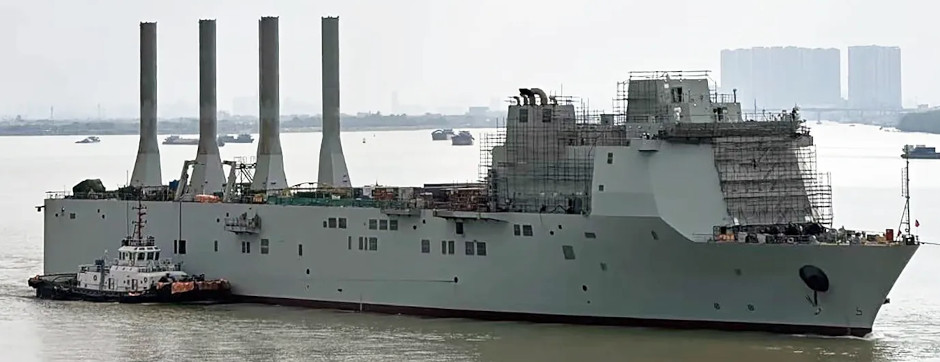 The second mothership has noticibly taller lifting pillars compared to the first ship.
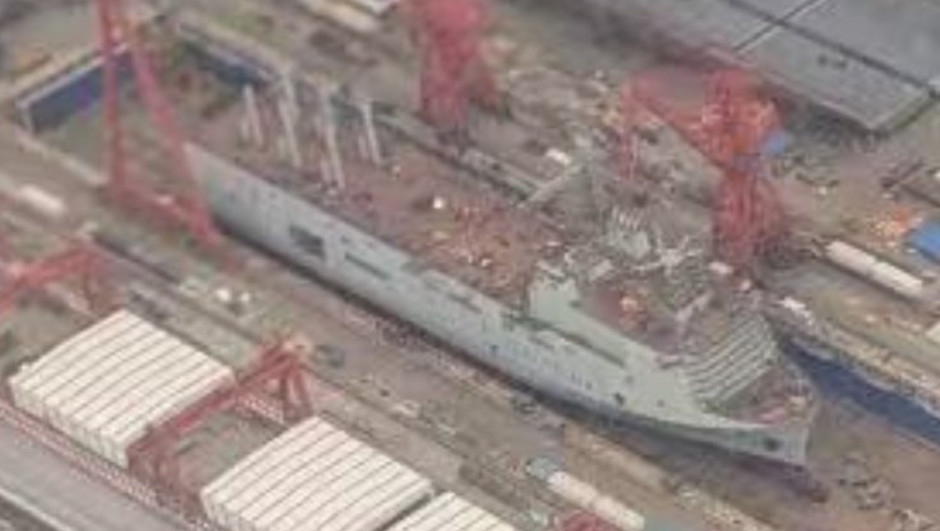 The first mothership was built in Shanghai during construction. Note that the casings have not yet been added over the lifting pillars in this photo.
The Guangzhou vessel is lower so the taller pillars look noticeably larger. The rise about twice the height of the hull, whereas on the first Shanghai ship they are about the same height at the hull. This ration is likely to be the main identification feature, especially at a distance. The hulls are also quite different, with the Guangzhou ship having vertical sides whereas the Shanghai one has a noticeable chine running along the lower hull and inward sloping sides.
It is unclear whether these are competing designs, or simply a sign that the construction of a fleet of support vessels is likely to be farmed out to more than one yard.
Related articles (Full index of popular Covert Shores articles)
 China’s semi-submersible trimaran possible arsenal ship.

 Taiwan’s indiginous Hai Kun Class submarine.

 Indonesia’s KSOT XLUUV