

Nautilus - homage to Jules Verne
 There are very few fictional submarines which have a place in Naval architecture history. The Nautilus, an electric powered submarine conceived in the 1860s by author and visionary Jules Verne stands out. It was a window into the future and possibly an influence on subsequent real world designs. I set about illustrating the Nautilus after being inspired while drawing a detailed cutaway of the interesting spy-submarine USS Halibut for the Covert Shores Book. Additionally I may have been influenced by some recent Verne related illustrations I did for another book project by C.E. Davis (The Lunarnauts 1904)

My own interpretation of the Nautilus - CLICK for HIGH-RESOLUTION image.
Jules Verne created the submarine for his classic novel 20,000 Leagues Under the Sea. In it the submarine’s troubled captain, Nemo, sets out to take revenge on civilization by ramming and sinking ships. Nemo has sought refuge in the natural environment of the ocean, roaming in the highly sophisticated Nautilus. Since publication the submarine has caught the attention of generations of readers and submariners.
Exact details of the design are sparse but it is consistently described as cigar shaped with pointed ends and 70m long and 8m wide. The forward end is used to ram enemy ships (Verne was writing at exactly the time that ‘locomotive torpedoes’ were introduced to the world by British engineer Robert Whitehead, but Verne does not reference this development). The submarine is double-hulled for at least part of the way, and driven by a large propeller at the back.

For diving control the Nautilus uses large hydroplanes mounted at the center of buoyancy. It has no rear hydroplanes but does have a rudder. There is no sail as we understand it but a small retractable pilothouse with viewing ports (this was thirty years before periscopes were introduced to submarines) is used for navigation. A second superstructure further aft houses a lamp. The most important characteristic is the large viewing ports located either side of the spacious salon which takes up the full width of the submarine.
THE book on Special Forces subs Covert Shores 2nd Edition. A world history of naval Special Forces, their missions and their specialist vehicles. SEALs, SBS, COMSUBIN, Sh-13, Spetsnaz, Kampfschwimmers, Commando Hubert, 4RR and many more.
Check it out on Amazon
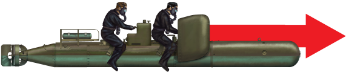
Verne also conceived of divers using self-contained breathing apparatus involving compressed air, almost 80 years before it became the reality!
My attempt at the Nautilus
My design for Nautilus stays with the overall description from the book but incorporates several features of my own contrivance. Please forgive the artistic licence. In a nod to real-world submarine design I replaced the retractable pilot house with a fixed structure which would avoid the telescopic interface which I think would leak. I also shifted the hydroplanes further forward to directly below the pilot house to simplify control mechanisms and mounted them lower on the hull so that the axle passes below floor level. Further aft I kept the problematic sodium-mercury batteries and electromagnetic motor but opted for twin screws (propellers) to allow a fanciful fish-like rudder arrangement.

Original artwork - CLICK for HIGH-RESOLUTION image.
Key
1 . Armored piercing steel ram
2 . Frontal armor
3 . Ram mounting with sheer joint
4 . Safe hidden behind paneling
5 . Captain’s bed
6 . Ghastly Victorian wallpaper
7 . Captain Nemo’s cabin
8 . Library
9 . Crank for anchor chain
10 . Salon with round viewing ports
11 . Pipe organ
12 . Dinning room
13 . Steel fender
14 . Forward viewing ports
15 . Wheel
16 . Pilot house
17 . Galley
18 . Wheel to open main hatch from outside
19 . Main hatch with spiral staircase (opens upwards)
20 . Divers’ room
21 . Dinghy
22 . Latrine
23 . Dry stores
24 . Rear steel fender
25 . Telescopic light post
26 . Speaking tube
27 . Sealable air inlet
28 . Watch keeper’s station (surfaced)
29 . Crew’s access hatch
30 . Crew’s mess and accommodation
31 . Engine room
32 . Horizontally opposed electro-magnetic motor
33 . Steering room
34 . Upper rudder
35 . Lower rudder
36 . Twin bronze screws (propellers)
37 . Water condenser
38 . Sodium-Mercury batteries
39 . Diver lock-out chamber
40 . Diver’s hatch
41 . Diver’s locker
42 . Main hatch opening mechanism
43 . Wet hold for plunder
44 . Main hydroplane control mechanism
45 . Trim weight (moved forward-aft to adjust attitude)
46 . Compressed air for blowing ballast tanks
47 . Anchor
48 . Chain locker
49 . Iron keel
Probable influences on Verne
Jules Verne did not invent submarines, but he did take on board the advances of his time and extrapolated them into the submarines of the (then) future. The 1860s was a time of increased interest and efforts in submarines. In particular the Civil War created a climate for submarine development as the Confederate Navy sought unconventional means to neutralize the dominant Northern fleet. The most famous of these was the H L Hunley submarine but the earlier Pioneer from the same engineers was an even closer fit to Nautilus. It had a tubular hull with conical ends. These subs were small with the propeller driven by hand-cranks but outwardly they resembled the Nautilus and attacked their enemy by ramming (albeit with an explosive ‘torpedo’). - Note, Civil War subs are covered in the Covert Shores Book.

 Confederate submarine Pioneer
The Confederate States also developed cigar-shaped semi-submersible boats which allowed steam propulsion, again attacking by means of a ram-torpedo.

David class semi-submersible
Much larger but less well known was another Confederate submarine designed by a Mr Alstitt. It fatured a steam engine for surface running and had two decks, but very little is known and the design *as illustrated below) does not appear very watertight.

Alstitt’s design for a submarine
Closer to home Verne would ave been aware of the le Plongeur submarine designed by Captain Siméon Bourgeois and launched in 1863. Unlke he Confederate submarines this was propelled by means of compressed air which was stored in large cylinders which took up most of its hull. Although ultimately unsuccessful, a lot of hope was placed in the design.

Le-Plongeur, credit Lamgi Mari
Another probable influence was a series of ‘cigar ships’ built by American shipbuilders Winans from 1859 onwards. Although not submersible,their spindle hulls resembled the description of Nautilus. Their concept was a fully enclosed wave-piecing hull with minimal superstructure. They also boasted various unusual propeller configurations including a central wrap-around propeller and twin props mounted on both ends of the hull. Finding limited interest in America they moved their operations to Europe with one boat being built in Russia ad another in France. And they were all over the press at the time, albeit viewed mostly as a costly folly.

 Winan’s first cigar ship in Baltimore Harbor
The Nautilus differed from all these submarines in one important aspect; propulsion. Verne envisaged an electrically powered submarine. The means for harnessing electricity was relatively technology and Vernes overcame the problem of charging the batteries by imagining a Sodium-Mercury compound which could be replenished from salt extracted from seawater. This was not scientifically sound, but accepting this workaround to the then seemingly insurmountable problem of battery life, Vernes was projecting the future of electrically powered submarines. The electric motor described was another scientific improbability, using opposing electromagnets like pistons, but again this does not detract from his foresight.
Get The essential guide to World Submarines
This Covert Shores Recognition Guide Covers over 80 classes of submarines including all types currently in service with World Navies.
Check it out on Amazon

Trivia
The popular image of the Nautilus submarine is actually the creation of Disney for the 1954 film 20,000 Leagues Under the Sea. It is an interesting design but quite different from Verne’s description. More recently, Herve Jaubert, a French-born submarine designer built a private sub of similar appearance for wealthy clients. What connects that to this site is that Jaubert is also an SDV maker although some of his designs are still secret (again, a Covert Shores Covert Shores Book plug!).

Herve Jaubert’s Nautilus inspired leisure sub
Further Reading
Vernianera - massive Nautilus site
an interesting take on the design
Related articles (Full index of popular Covert Shores articles)
 Nautilus 2020 Luxury Private Submarine. w/Cutaway
 Surcouf Cruiser Submarine w/Cutaway
 Turbinia, the first steam turbine boat (1894)
 Armored Stealth Boat used for car smuggling by Chinese organized crime. w/Cutaway
 Narco Subs 101. w/Cutaway
 LTTE Sea Tigers’ sneak craft and midget subs
 Unofficial USN Diesel Submarine concept. w/Cutaway
